Long-term relationship - These qualities are particularly important to us
Are long-term relationships a rarity these days? And do users of online dating apps and matchmaking services usually only look for something casual, a short-term fling? Our representative study shows the opposite! Most people want long-term relationships.
Read on to find out which characteristics most Germans consider important for maintaining a long-term relationship and what different desires younger and older singles have for their partnerships. And did you know how long a relationship lasts on average in Germany?
How long do couples in Germany stay together on average?
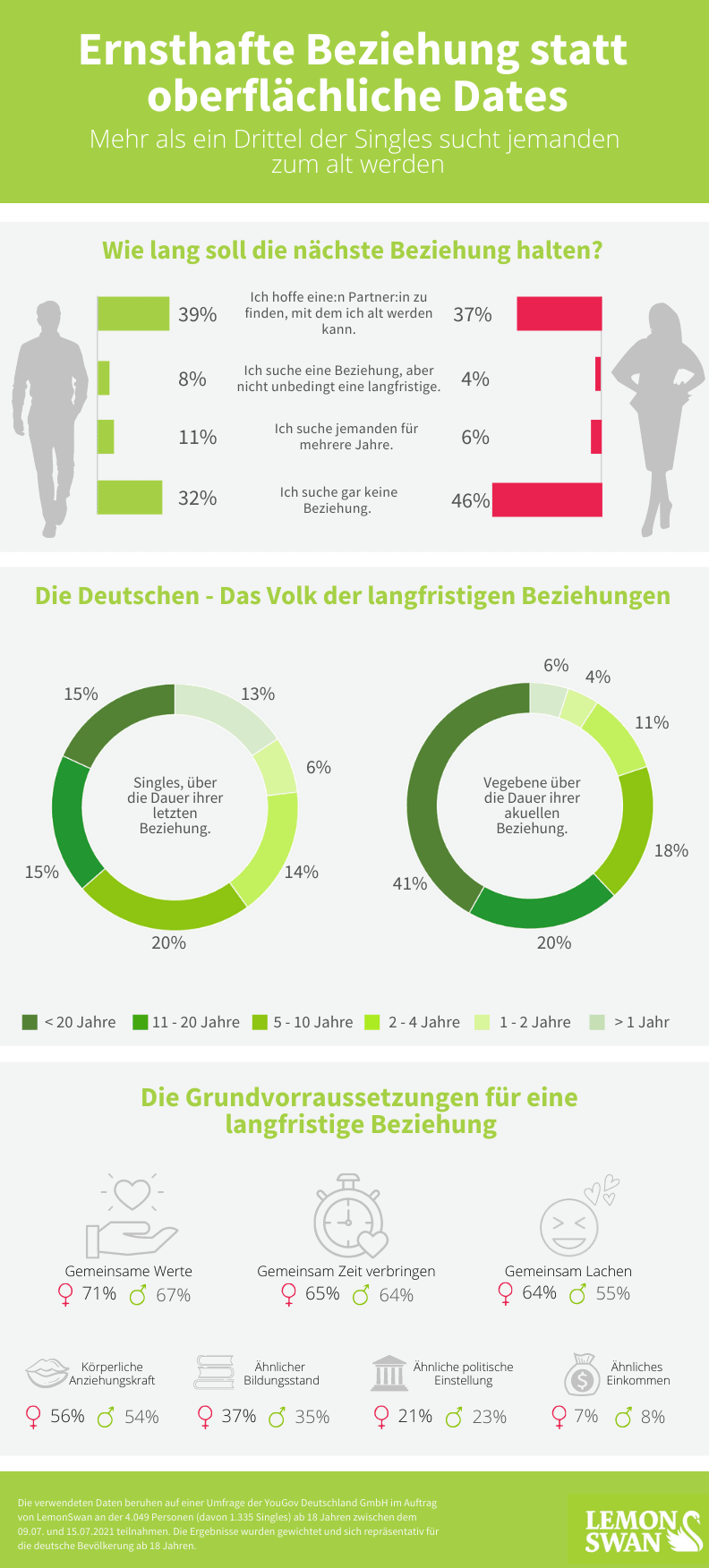
It's not true that nobody wants or is able to commit to a long-term relationship these days. 61 percent of people in relationships in Germany have been with their partner for more than eleven years. 41 percent of them have even been together for more than 20 years.
The picture is similar among respondents who are not currently in a committed relationship. 30 percent of them have had a long-term relationship that lasted more than eleven years. Only one in ten has never had a relationship that lasted beyond the first anniversary.
And how long do couples in Germany stay together on average? Our results showed an average relationship length of ten years.
Long-term relationships remain the ideal
We asked all respondents who are currently single how long they would like their next relationship to last. The result: a desire for long-term relationships.
Two out of five singles (39 percent) want a long-term partnership. Almost as many (38 percent) are looking for someone to grow old with. Younger singles in particular long for a partnership that will last a lifetime. Half of those aged
25-34 want exactly that for their next relationship.
Particularly interesting: The older generation aged 55+ seems to thoroughly enjoy their single life. Of these, 59 percent say they are not currently looking for a relationship. Across all age groups, women (46 percent) say this significantly more often than men (32 percent).
What qualities are important for a long-term relationship?
What qualities are particularly important for a relationship to last? Of course, every relationship is unique, and we humans have different, very individual expectations of our partnerships. Nevertheless, our survey shows that there are definitely some commonalities.
1st place: Shared values
For 69 percent of respondents, shared values and worldviews are an important prerequisite for maintaining their relationship in the long term. This is even slightly more important to female respondents (71 percent) than to men (67 percent). These characteristics also become more important with age (63 percent among 18-24-year-olds, 72 percent among those over 55).
There is also a clear difference in terms of educational attainment. While shared values are decisive for only 30 percent of respondents without a degree, 77 percent of respondents with a high school diploma say the same.
2nd place: Shared interests and hobbies
Shared hobbies and interests form the basis for a long-term relationship. Men (64 percent) and women (65 percent) are in broad agreement on this point. However, there is also a clear age difference here. While these characteristics are important for 57 percent of 18-24-year-olds, 71 percent of respondents over 55 agree.
3rd place: A similar sense of humor as the basis for long-term relationships
When it comes to humor, all age groups agree: laughing together promotes the long-term maintenance of a relationship. Women agree with this statement even more often than men (64% women, 55% men).
4th place: Physical attraction
Just over half of respondents (55%) said that a high level of physical attraction is also important to them for a long-term relationship. There is broad agreement on this issue among male and female respondents and across different generations.
5th place: A similar level of education
The level of education of one's partner is becoming increasingly unimportant, especially for the younger generation. Only 23 percent of 18- to 24-year-olds consider a similar level of education to be important for a long-term relationship. In the 55 and older age group, however, the picture is quite different. Here, 40 percent of respondents consider this commonality to be an important prerequisite.
6th place: Similar political views
The opposite picture emerges when it comes to political views. While 19 percent of those aged 55 and older consider this to be important, almost one in three (26 percent) of those aged 18 to 24 think so.
7th place: Similar income rarely a prerequisite for long-term relationships
Good news: less than one in ten respondents consider a similar income to be important for a long-term relationship to work. Men (8 percent) and women (7 percent) agree on this issue.
Conclusion: Long-term relationships are based on a strong foundation of shared values
The results of our study show very clearly that a strong foundation of shared values is important for a relationship to work in the long term. This shared foundation ensures that getting to know each other is interesting, that there are topics to talk about, and that both partners feel comfortable. This creates the perfect foundation for people to fall in love with each other.