Women and online dating—couples therapist Ingrid Strobel explains
We asked Ingrid Strobel, who not only deals with relationships as a couples therapist in Augsburg, but has also written a book about how choosing a partner should be approached not only with the heart, but also with the mind.
She also gives valuable tips on how to make your big dream come true. She personally found her private happiness online, which is why we wanted to know how she got on and what women are looking for when searching for a partner online.
Why did you decide to look for a partner online?
Because I had a clear idea of what I was looking for in a partner and wanted to take a systematic approach. An online dating service allowed me to search and select within a radius that I defined myself. I was also able to narrow down the partners I was interested in based on their personality profiles. Looking for a partner in the “wild,” on the other hand, seemed very tedious, time-consuming, and unlikely to be successful.
How did online dating work for you?
To be honest, I had to get used to the process first. I quickly realized that the selection process was very tough and that I was sometimes rejected without explanation. At first, that wasn't exactly great for my female self-confidence. But the more I dealt with it, the more relaxed and humorous I was able to be about it. And eventually, I also used the button to say goodbye every now and then.
What advantages does online dating offer you, and how do you view dating in later life in this context?
Well, the advantages are obvious to me. I would never have met my partner, whom I found through an online dating agency, in real life. If only because he lives 80 kilometers away and because we are at an age where we no longer conquer the world in flirtatious and conquering mode. Most people our age, i.e., over fifty, are either in a relationship or, if single, hardly visible in society. Online dating makes them visible again.
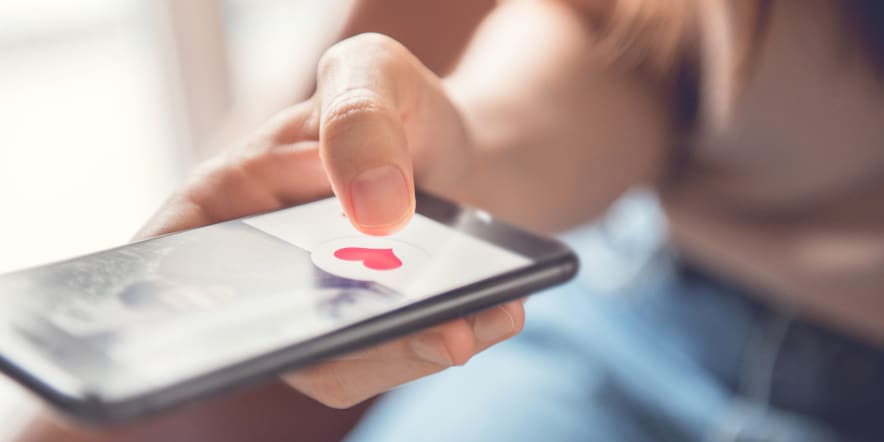
Tell us your success story about finding a partner online
As I said, it took some getting used to at first. But over time, I learned how to deal with it. In the beginning, it was more of a trial and error process with some frustrations. But I thought it was important to have a plan, it just takes practice and perseverance to implement it in the best possible way.
I also had to learn that, as a woman, I couldn't just wait around, but had to be proactive. That took a lot of effort on my part, because my generation has internalized different values in this regard. Once I got over all that, it started to be really fun. I became more and more courageous and was rewarded for it.
First dates followed with good conversations, which developed into nice contacts, but the right man wasn't there for me at first. During this time, I also wrote my book “Decide who you want to love.” In summary, I can say that I had to be patient, embrace new approaches in some areas, and try to be tolerant of myself and others. Although you can make a preliminary selection online, in the end, it's no substitute for a real meeting.
That's why I didn't shy away from meeting the men who made the shortlist as soon as possible. And I didn't weigh everything that happened on the first date too heavily. I was usually a little nervous, and so was my date, so it's easy to put your foot in your mouth in ways you would normally have carefully avoided.
Please explain the difference between love and infatuation.
Infatuation is an exceptional state that is intoxicating and of limited duration. In most cases, this state subsides after one to four years at the latest. For many, however, the sobering hangover of love sets in after around twelve months, depending on their personal tolerance for frustration. The butterflies in your stomach are gone, and suddenly what you previously found cute is annoying.
It doesn't take much to fall in love: you have to find the other person attractive and like their smell. If there's a bit of adrenaline involved, then falling in love happens quite quickly. Love is different. It doesn't need intoxication to establish itself, but it does need shared values and goals, a similar level of education, similar interests, and a similar age. And when it comes to sexuality, you should also be on the same page. It would also be helpful to be largely in agreement in your thoughts and actions.
Infatuation is something that happens to us and is not very stable. Love, on the other hand, is the expression of what connects us and what makes the relationship grow. And it is generally stable.
You claim that it is possible to love without being in love—how does that work?
By giving love time and looking at the relationship with your mind. Love needs time and patience and the will to work on yourself and the relationship every day. Working on the relationship does not mean working on your partner. Love also means accepting the other person's personality as it is. If you can't do that, then you should check whether the prerequisites for love are actually present.
I believe that if you find your partner likable and attractive, you get along well, and the aforementioned prerequisites are present, then you should give love a chance, even if you don't feel butterflies in your stomach. It just takes time and a clear decision to get involved. And of course, it takes work and doesn't happen automatically like when you're infatuated. But in return, the whole thing is more successful in the long run than pure infatuation.
What are the biggest potential sources of conflict when looking for a partner and in a relationship?
When you're not looking in the same direction.
When your values and morals are too far apart.
When you have hardly anything in common.
Silence and not talking to each other about your feelings, desires, and needs is poison for a relationship.
Too little mutual appreciation.
A thrifty person will be unhappy with a wasteful person. And a couch potato will not find peace in the long run with an energetic sports fanatic.
What women want
You have years of experience—what do women want when looking for a partner? I think most women want to be courted. That's still the case today, just as it was when I was young. And when it comes to a long-term relationship, financial stability, reliability, and emotional competence are certainly important factors for women who are planning to start a family.
Familiarity also plays a role in choosing a partner. We tend to gravitate toward familiar faces because we associate them with a sense of security. A potential partner who resembles a beloved father is therefore more likely to score points than someone who doesn't fit the mold. For older people, the desire to spend free time with their partner is high on the list.
They want to enjoy the rest of their lives with their partner and no longer have to deal with so-called legacy issues. But even in this case, emotional competence and reliability are important factors.
What is typical dating behavior for women?
I think it always depends on the situation and the man she is with as to how she ultimately behaves. Otherwise, women tend to be more passive when it comes to taking the first step in dating. When dating, women like to talk a lot, especially when they are a little nervous. There's nothing wrong with that; after all, you're supposed to get to know each other. But to keep things from becoming one-sided, it would be helpful to engage the listener in a dialogue with open-ended questions.
I am always amazed at the dedication with which we women analyze, almost dissect, what potential partners say about themselves and then put it back together like a puzzle depending on our mood. We know that a lot of nonsense comes out of it, but we just can't help ourselves. One way would be to simply ask questions to make sure you have understood something correctly. Or even better: wait and see, and let everything unfold at its own pace.
Women also tend to fall into the trap of admiring and agreeing with everything. Of course, this flatters a man's ego and can certainly score her some points, but here too, it's important not to overdo it and to express your own opinion, otherwise the conversation will quickly become boring and one-sided.
A woman's gut feeling is certainly a good source of intuition, but sometimes even what seems obvious can be deceptive. So when dating, you should follow your intuition, but not let it control you. And chasing after someone when there's been a spark would be fatal. It would also be a shame not to enjoy the thrill of uncertainty, so that you can then rejoice wholeheartedly when your chosen one asks you out on another date.
What are the biggest differences between women and men when it comes to love and relationships?
Men
Men are somewhat more pragmatic than women. They don't constantly worry about what should or shouldn't happen in a relationship.
As a rule, they don't try to change their partner.
When men love, they love the whole package. They are rarely able or willing to differentiate why they love this particular woman. Their love is often expressed through sexuality or by giving their partner gifts, taking work off her hands, spending time with her, and providing financial security.
Women
Women, on the other hand, are constantly thinking about things. Unfortunately, this is not a cliché. We ourselves suffer from not being able to switch off.
Unfortunately, women also tend to want to change their partners.
Women are a little more nuanced. They find many reasons why they love their partners and think about how they can keep the relationship alive and happy.
Their love is expressed through tenderness and intense communication.
What do women want in a relationship these days?
Reliability, security, and appreciation. But I think that goes both ways. Reliability makes you feel safe and secure with your partner. And appreciation leads to mindfulness in how you treat each other.


